How to Know How Long a Reformer Pilates Class Lasts

Updated: Nov 11
Last Updated: November 8, 2026
Quick Summary
A reformer Pilates class typically lasts 45 to 60 minutes, with most group classes running 45, 50, or 60 minutes and private sessions often filling the full hour. Most first-timers should plan on about 50 minutes for a group class, plus a few minutes on each end to settle in and cool down.
A 50-minute group class is the sweet spot for most beginners, long enough for full-body work without wiping you out.
A 45-minute class usually trims transitions and keeps the pace brisk, while a 60-minute session allows a longer warm-up and cool-down.
Reformer classes spend a few minutes adjusting springs, straps, and footbars, so a 50-minute reformer class may have less continuous movement than mat.
Many beginners start with two classes a week to give muscles time to recover between sessions.
Match class length to your recovery window: a 45-minute class leaves more room if you are squeezing in a session between other workouts.
Not sure which class length fits you?
Try a reformer class at FLX FLO Pilates and find the format that works for your body.
Table of Contents
How Long Does a Reformer Pilates Class Last?
Most reformer Pilates classes run 45 to 60 minutes, and that range holds whether you are brand new or years into your practice. Most first-timers should plan on about 50 minutes for a group class, plus a few minutes on each end to settle in and cool down. The exact length depends on the studio, the class level, and the format you pick. (Source: a 2026 report on fitness trends)
Here is the part most guides skip: the number on the schedule is not the same as time under tension. A 45-minute class and a 60-minute class can deliver a similar workout if the shorter one moves faster and rests less. Below, we break down what each length actually gives you, what happens inside the scheduled minutes, and how to choose the right fit for your body and your week.
The Short Answer: 45 to 60 Minutes
A standard group reformer class lasts 45, 50, or 60 minutes. A private session often runs the full hour. Mat classes usually land in the same range, though they can be shorter because setup takes less time.
For most beginners, a 50-minute group class is the sweet spot. It is long enough for a full-body sequence and short enough that you are not wiped out for the rest of your day. If you are managing an old injury or you are completely new to the equipment, a 45-minute class can feel less daunting.
Why the 45-, 50-, and 60-Minute Split Exists
Class length is a design choice, not a rule. Studios pick a duration based on three things: how much setup the equipment needs, how many people are in the room, and what the class is meant to achieve.
A 45-minute class usually trims transitions and keeps the pace brisk. A 60-minute session has room for a longer warm-up, more time on the core, and a proper stretch at the end. The 50-minute format splits the difference, which is why it shows up so often on group schedules.
Here is how the three lengths typically compare:
Class Length | Best For | What It Usually Includes |
45 minutes | Busy schedules, first-timers, lunch breaks | Fast warm-up, focused sequence, brief cool-down |
50 minutes | Most beginners and regulars | Balanced warm-up, full-body work, stretch |
60 minutes | Experienced practitioners, deep practice | Longer warm-up, more transitions, full cool-down |
How Long Is a Pilates Session, Mat Versus Reformer?
A Pilates session is the full block of time you book, and it runs about the same for mat and reformer: usually 45 to 60 minutes. The difference is not the clock. It is how that time gets used.
Mat work needs almost no setup. You roll out a mat and start. Reformer classes spend a few of those minutes adjusting springs, straps, and footbars, especially in a group setting where several people need help. That means a 50-minute reformer class may have slightly less continuous movement than a 50-minute mat class.
Reformer work also adds resistance and support that mat work cannot. The springs help you feel where your body is in space, which matters if you are rebuilding strength or recovering from an injury. For a closer look at how the two compare on cost and results, see our breakdown of whether reformer Pilates is worth it.
What to Expect at a Reformer Pilates Class
A reformer class is a guided full-body workout on a spring-loaded carriage. You will move through a sequence of exercises lying on your back, on your stomach, kneeling, seated, and standing, with the reformer's straps and platform supporting or challenging your position.
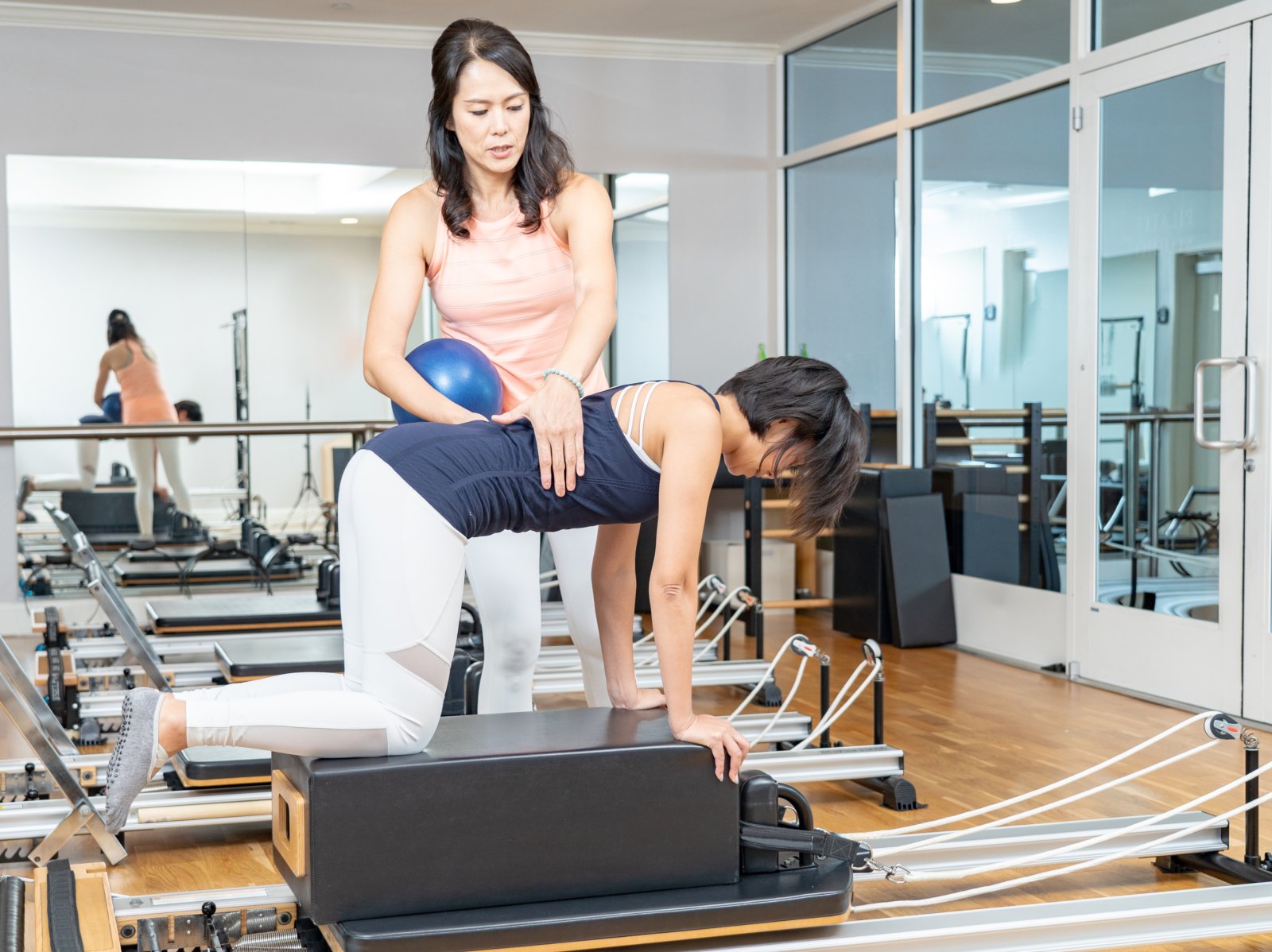
Your first class will feel unfamiliar, and that is normal. The instructor calls out spring settings and body positions, and you follow along at your own pace.

What the Scheduled Class Time Actually Includes
The number on the schedule is the block you book, and it usually covers more than continuous exercise. Here is what typically happens inside a 50-minute group reformer class, and what falls outside it:
Before the clock starts (5-10 minutes): Check in, stow your things, take off shoes, and meet your instructor. Arriving early gives the instructor time to set your springs and footbar before the group warms up.
Minutes 1-5 of class: Settle onto your reformer, adjust straps and springs, and begin a warm-up. In a full group, expect a minute or two of setup chatter as the instructor checks everyone's settings.
Minutes 5-15: Footwork and leg work to wake up the lower body.
Minutes 15-35: Main sequence covering core, arms, back, and hips, with short transitions between positions.
Minutes 35-45: Standing work and balance challenges.
Minutes 45-50: Cool-down and stretch.
After class (5-10 minutes): Wipe down your reformer if the studio asks, put away props, and change. Some studios build a few minutes of cleanup into the scheduled block; others expect it after.
Watch out: if you arrive exactly at the start time for your first class, you may miss the setup instructions and spend the warm-up catching up. Arrive early enough to be on the reformer before the instructor begins.
How Class Level Changes the Time Breakdown
The minute-by-minute structure shifts with the class level and format: (Source: the benefits of Pilates for core strength and posture)
The exact sequence varies by instructor and class level. What stays constant is the structure: warm up, work, cool down, and the fact that the scheduled time includes more than the workout itself.
How Often Should I Do Reformer Pilates as a Beginner?
Many beginners start with two classes a week, which gives muscles time to recover between sessions while building consistency.
More is not automatically better. Reformer work asks a lot of your core and stabilizer muscles, and those need rest to adapt. A common mistake is jumping into four or five classes in the first week, then burning out or tweaking something. Build up slowly.
If you want a local guide to beginner-friendly options and first-class tips, our beginner reformer Pilates guide for the area walks through what to look for.
How Long Does a Reformer Pilates Class Last at Home?
At-home work has real limits. A home reformer or a mat-based routine can build strength, but you lose the instructor's eye on your form. If you are new to the method, a few studio classes first will teach you the positions well enough to practice safely on your own.
Does Class Length Change What You Get Out of It?
Longer does not always mean better. What you get out of a class depends more on consistency and movement quality than on the clock.
A 45-minute class done twice a week will do more for your strength and posture than a single 60-minute class you dread. The body responds to repeated, well-executed movement, not to one long session.
That said, length does shape the experience:
Changes in body awareness, posture, and strength tend to develop gradually over time and vary from person to person.
How to Choose the Right Class Length for You
Pick your class length based on three things: your experience with the equipment, what you want from the session, and how much recovery time you have before your next workout. Here is how those factors point to a length:
A simple way to decide: match the class length to your recovery window. If you plan to attend again in two days, a 50- or 60-minute class is reasonable. If you are squeezing in a session between other workouts, a 45-minute class leaves more room to recover.
If you are unsure, book one class at each length and see how your body responds. You can browse the class formats and levels we offer to compare options before you commit.
Planning Your First Reformer Class at FLX FLO Pilates
Your first class is mostly about showing up ready to learn. Wear fitted clothing that will not catch on the carriage, bring water, and arrive a few minutes early so you can meet your instructor and get set up.
At FLX FLO Pilates, we focus on postural integrity and deep core activation, and we meet you where you are.
Ready to see the schedule and pick a time that fits your week? You can view the class schedule and find a slot that works. If you are new, the three-class intro offer is a low-pressure way to try a few sessions and find the length that suits you.
Class length is only one piece of the puzzle. The bigger factor is finding a studio where the pace, the instruction, and the group feel right for your body. At FLX FLO Pilates, we build each session around postural integrity, deep core activation, and sustainable strength, so you move better rather than just more. Get started with FLX FLO Pilates and find the class length that keeps you coming back.
Frequently Asked Questions
How long does a reformer Pilates class usually last?
Most reformer Pilates classes run 45, 50, or 60 minutes. The 50-minute group class is the most common format, while 45-minute sessions tend to be faster-paced or aimed at lunchtime schedules, and 60-minute sessions leave more room for warm-up, transitions, and stretching. Private sessions can run shorter or longer depending on your goals. Ask the studio what the scheduled time includes before you book, since arrival and setup usually happen outside the class itself.
Should beginners take a shorter reformer Pilates class?
A 45- or 50-minute beginner class is often the easier starting point, because learning the reformer's carriage, springs, and strap settings takes concentration. Shorter sessions let you focus on form without fatigue setting in. That said, a well-taught 60-minute beginner class paced for new students works fine too. What matters more than length is whether the class is labeled for beginners and whether the instructor checks your setup before the exercise sequence begins.
How often should I do reformer Pilates as a beginner to notice a change?
Two classes a week is a realistic starting schedule for most beginners, with a rest day between sessions so your muscles recover. Many people move to three classes a week once the movements feel familiar. Changes in posture and core strength are gradual, so judge progress over weeks of consistent practice rather than a single session. If you are recovering from an injury, clear the frequency with your healthcare provider first.
How early should I arrive for my first reformer Pilates class?
Arrive 10 to 15 minutes early for your first class. That window covers check-in, a studio tour, and learning how to set your footbar, springs, and straps before the session starts. Instructors also use that time to ask about injuries or limitations so they can offer modifications. Arriving flustered and late means the warm-up happens without you, and the reformer setup gets rushed.