How to Start Pilates at 50: A Beginner's Guide

Table of Contents
Why Pilates at 50 Makes Sense for Strength and Mobility
Health Screening and When to Consult Your Doctor Before Starting
Reformer Pilates for Beginners: What to Expect and How It Works
Mat Pilates for Beginners: Starting on the Floor
Your First Month: A Practical Beginner Plan
How Often to Do Pilates as a Beginner and Progress Safely
How Long to See Results from Pilates and What to Track
Finding the Right Instructor and Studio for Your Needs
Last Updated: October 11, 2026
Why Pilates at 50 Makes Sense for Strength and Mobility
When you start pilates at 50, you build strength without joint stress. Unlike heavy weights or intense workouts, pilates emphasizes controlled movements, deep core activation, and postural alignment, exactly what your body needs at this stage of life.
Pilates directly targets age-related changes: declining muscle, forward posture from desk work, and reduced mobility.
Adults over 50 who start pilates experience practical improvements: climbing stairs feels easier, reaching overhead becomes fluid, and back pain decreases.
Low-impact exercise protects joints while building strength. You're moving with intention, not pounding pavement or jumping.
Pro Tip The biggest advantage of starting pilates at 50 is that it works WITH your body, not against it. Controlled resistance builds muscle without the recovery demands of heavier training.
Health Screening and When to Consult Your Doctor Before Starting
Before you start pilates at 50, consult your healthcare provider, especially if you have a history of back problems, joint issues, or conditions affecting movement.
Your doctor identifies contraindications requiring modifications. A shoulder injury doesn't prevent pilates, your instructor just needs to know so they can adjust your program.
Most people over 50 can do pilates safely. These conditions require medical clearance first:
Recent surgery or significant injury
Severe osteoporosis
Uncontrolled high blood pressure
Heart conditions
Chronic pain that limits movement
A brief conversation with your doctor gives you confidence and your instructor the information needed to keep you safe.
Watch Out Never push through sharp pain during pilates. Discomfort is normal as you build strength. Sharp pain signals that something is wrong. Stop and tell your instructor immediately.
Reformer Pilates for Beginners: What to Expect and How It Works
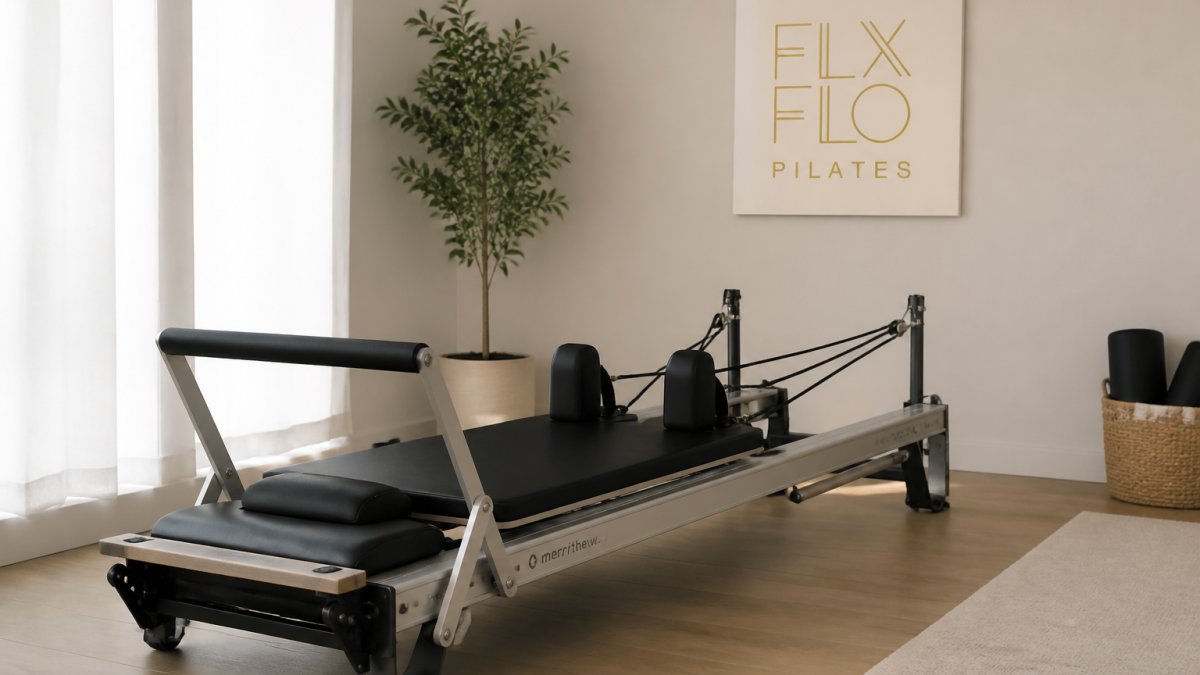
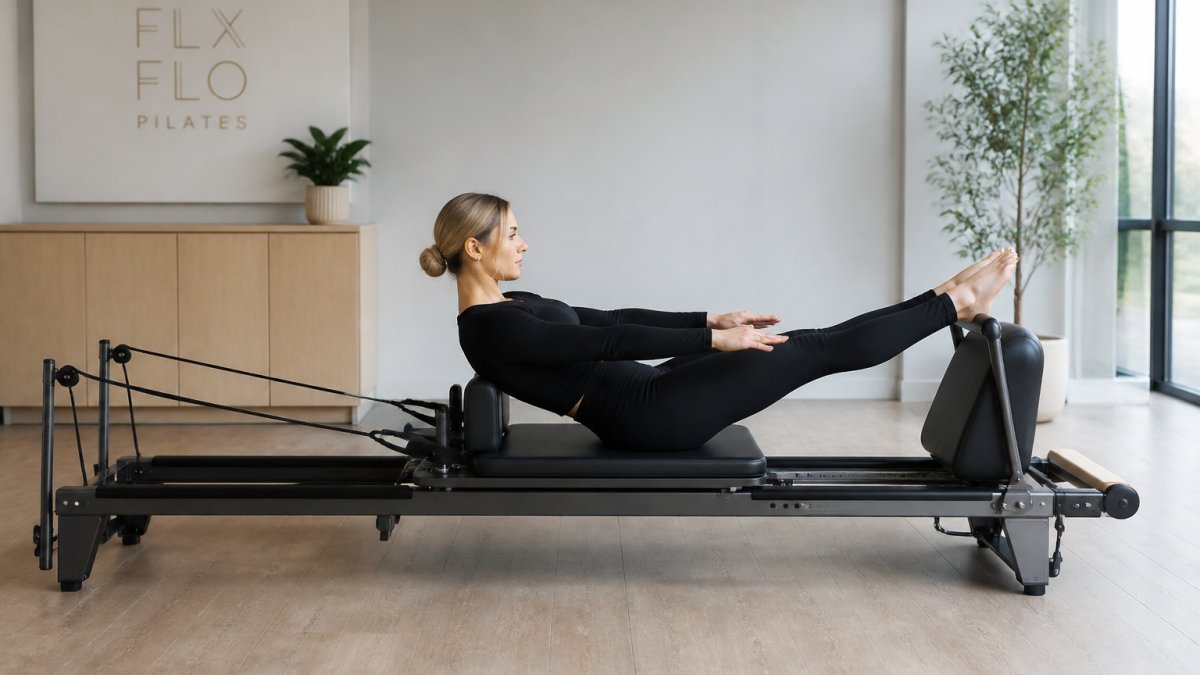
Reformer pilates uses springs, pulleys, and a sliding carriage. Though it looks intimidating, it's beginner-friendly, but not the only option for starting pilates at 50.
Before choosing reformer, understand the four main formats and how they compare:
Reformer Pilates
Best for: People with limited floor mobility, those who need joint support, anyone intimidated by balancing on a mat
How it works: Springs provide adjustable resistance; the carriage slides smoothly, reducing stabilization demands
Class length: Typically 45-60 minutes
Cost: Available on website (see FLX FLO Pilates pricing page) for studio classes
Access: Requires a studio membership or home space
Comfort factor: No floor work; you sit or lie on the machine
Mat Pilates
Best for: People comfortable on the floor, those seeking portability, anyone on a tight budget
How it works: Your body weight and gravity provide resistance; you do all stabilization yourself
Class length: Typically 45-60 minutes
Cost: Free to some cost per class; a mat costs some amount
Access: Anywhere, home, park, studio
Comfort factor: Requires getting down and up from the floor; more challenging for balance
Chair Pilates
Best for: People with severe mobility limitations, balance concerns, or those recovering from injury
How it works: You sit in or stand beside a sturdy chair; movements are modified and supported
Class length: Typically 30-45 minutes
Cost: Some cost per class; some community centers offer free or low-cost options
Access: Any room with a chair; many studios and senior centers offer classes
Comfort factor: Minimal floor work; very accessible for limited mobility
Wall Pilates
Best for: Beginners seeking simplicity, people with no equipment access, those building confidence before mat or reformer
How it works: You use a wall for support and alignment cues; bodyweight provides resistance
Class length: Typically 20-30 minutes
Cost: Free (home practice) or some cost per class
Access: Any wall; increasingly available as online classes
Comfort factor: Standing work; minimal balance demand; very low barrier to entry
How to choose: Limited floor mobility or joint pain? Try reformer or chair pilates. On a budget? Mat or wall pilates works. Unsure about commitment? Start with wall pilates at home for two weeks, it's free and builds confidence. Most people benefit from mixing formats: reformer twice weekly for strength, plus mat or wall work at home on other days.
Your first reformer class: Your instructor shows you how to adjust springs and set up the machine. You'll start with basic movements (footwork, feet-in-straps, arm work, etc.) performed slowly and deliberately. Expect mild soreness the next day, that's normal. A typical class includes a 5-10 minute warm-up, 30-40 minutes of controlled exercises, and 5 minutes of cool-down stretching.
The machine supports your spine and joints while resistance builds strength. Springs adjust the challenge. Lighter springs for beginners, heavier as you progress.

Mat Pilates for Beginners: Starting on the Floor
Mat pilates requires only a mat and your body weight.
Beginner Pilates for Women Over 50 | 25 Mins | Girl with the Pilates Mat
The Girl With The Pilates Mat
How you perform movements matters more than which movements you do. Here are foundational beginner modifications and safety cues:
The Pilates Breath (Foundation for All Movements)
Inhale through your nose for 4 counts, expanding your ribcage sideways and back (not your belly).
Neutral Spine Alignment (The Starting Position for Everything)
Lie on your back with knees bent, feet flat and hip-width apart.
Beginner Modifications for Common Movements
The Hundred (Core Engagement): Keep head and shoulders on mat; pump arms while engaging core. If lower back arches, stop, your core isn't ready yet.
Single Leg Circles (Hip Mobility): Bend the working leg and make smaller circles. Your pelvis should not rock; smaller circles are better. (Source: the National Osteoporosis Foundation's recommendations)
Rolling Like a Ball (Spinal Mobility): Roll only to mid-back, holding your thighs. Never roll onto your neck.
Leg Lifts (Leg Strength): Keep one knee bent with foot on floor; lift the other leg only 6 inches. Your lower back stays pressed to the mat.
The Bridge (Glute and Core): Lift hips halfway; hold for 3 breaths. Weight in heels and mid-back, not your neck.
When to Stop or Modify
Know the difference between productive discomfort and pain:
Productive discomfort: Muscle fatigue, mild burning in your core, feeling muscles working
Pain to stop: Sharp pain, pinching, numbness, tingling, or pain in your joints
If you feel pain, stop immediately. Tell your instructor. Pain is information, it means something isn't right for your body today.
Common Beginner Mistakes to Avoid: Don't rush, pilates is slow. Don't hold your breath; breath drives movement. Don't overarch your lower back; keep your core engaged.
Mat work is portable and can be done at home.
Pro Tip Start with just three movements per session: breathing practice, neutral spine holds, and one basic exercise like the bridge. Master these before adding more. Your nervous system needs time to learn proper form.
Your First Month: A Practical Beginner Plan
Your first month sets the foundation. The goal isn't to be perfect. It's to build consistency and learn proper form.
Week 1-2: Introduction and Exploration
Attend 2 classes per week (reformer or mat, your choice)
Focus entirely on learning proper breathing and alignment
Don't worry about how many reps you do
Ask your instructor to watch your form and correct it
Week 3-4: Building Awareness
Continue 2 classes per week
Add one 15-minute mat session at home (optional)
Notice which movements feel harder, these are your priority areas
Start tracking how you feel: energy, posture, any aches that improve
Your first month is about showing up consistently and learning. Strength comes later. Right now, you're teaching your body what pilates feels like.
Key Takeaway Consistency matters more than intensity in month one. Two classes per week beats one intense session. Your nervous system needs time to learn the movements.
How Often to Do Pilates as a Beginner and Progress Safely
Most people benefit from 2-3 pilates classes per week. Here's the progression:
Timeline | Frequency | Focus | What to Add |
Weeks 1-4 | 2x per week | Form and breathing | Nothing yet |
Weeks 5-8 | 2-3x per week | Adding challenge | Light home practice |
Weeks 9-12 | 3x per week | Building strength | Varied class types |
Month 4+ | 3-4x per week | Advancing difficulty | Personal goals |
Rest days matter, muscles build during recovery, not during workouts. Three classes per week with rest days between is ideal for most people starting pilates at 50. If you're exhausted after class, you're doing too much.
Progress safely: ask for modifications (not progressions), increase reps before difficulty, and take a deload week every 4-6 weeks.
How Long to See Results from Pilates and What to Track
Results appear on different timelines. In 2-4 weeks: better posture, less back tension, easier breathing, improved sleep. In 6-12 weeks: visible core definition, stronger legs and arms, better balance, increased flexibility. Individual results vary, injury recovery may show dramatic changes in 4 weeks, while pure strength building takes 12 weeks.
Track progress this way:
Take a posture photo (side view) at the start
Note which movements feel hard
Track your energy level throughout the day
Measure how you feel, not just how you look
Retake the posture photo every 6 weeks
Results are real. They just don't always show up on a scale.
Finding the Right Instructor and Studio for Your Needs
Your instructor makes the difference between a good experience and a transformative one. The right teacher understands how to modify movements for your body, listens to your concerns, and explains why you're doing each exercise.
What to look for in an instructor:
Pilates certification
Experience teaching adults over 50
Ability to modify movements without making you feel limited
Clear communication about form and breathing
Interest in your goals, not just getting through the class
When evaluating a studio:
Does the environment feel welcoming and non-judgmental?
Are classes small enough for individual attention?
Do they offer an intro class?
Can they accommodate your schedule?
Do instructors ask about injuries or limitations before class?
At FLX FLO Pilates, our approach is built on education and personalization. We meet you where you are and evolve with your practice. Every instructor is trained to work with people at all levels, including those starting pilates at 50 with no prior experience.
The right studio feels like a place where you belong, not a place where you're trying to keep up.
Starting pilates at 50 is one of the most effective ways to rebuild strength, improve mobility, and feel more confident in your body. The key is finding an environment where you feel supported and instructors who understand how to work with your body. FLX FLO Pilates specializes in personalized, mindful movement designed for sustainable strength and postural integrity. Book a class today and experience how intentional movement can transform the way you feel.
Book Class