Reformer Pilates for Desk Workers: A Beginner's Guide

Table of Contents
How Desk Work Affects Your Posture and Mobility
Pilates for Desk Posture: Why Reformer Pilates Works
Pilates Exercises for Office Workers: A Reformer Routine
Before You Start: Equipment Setup and Safety
Five-Minute Desk-Worker Series
Reformer Pilates Frequency for Beginners: How Often to Practice
Reformer Pilates vs Mat Pilates: Which Is Better for Your Desk Job
Common Mistakes and How to Modify for Your Body
What to Expect: Realistic Outcomes and Timeline
Common Mistakes and How to Modify for Your Body
Frequently Asked Questions
Last Updated: October 18, 2026
How Desk Work Affects Your Posture and Mobility
Sitting at a desk for eight hours a day changes your body. Your chest tightens. Your shoulders round forward. Your hip flexors shorten. Your glutes go quiet. This isn't just discomfort, it's a postural shift that compounds over months and years. (Source: a 2026 study on sedentary behavior)
The problem starts simple. When you sit, your body settles into a shape that feels stable but isn't actually healthy. Your thoracic spine loses its natural curve. Your upper-back muscles weaken from underuse. Your shoulders creep toward your ears. Over time, this static position becomes your default even when you stand up.
Most desk workers don't notice the damage until it's advanced. A tight chest makes breathing shallow. Weak glutes cause lower-back pain. Poor alignment creates tension in the neck. These aren't separate problems, they're all connected to prolonged sitting and the postural habits it creates.
The good news: movement breaks and targeted exercises can reverse this. That's where reformer pilates for desk workers becomes valuable. It addresses the exact muscles that sitting shuts down.
Key Takeaway Desk work creates predictable postural problems: rounded shoulders, tight chest, weak glutes, and reduced thoracic mobility. These patterns compound over time, but they're reversible with consistent movement.
Pilates for Desk Posture: Why Reformer Pilates Works
Reformer pilates for desk workers targets the specific muscles that sitting damages. Unlike mat Pilates or general fitness, a reformer uses spring resistance to activate stabilizers that desk work has silenced.
Here's what makes it effective: The reformer's springs provide calibrated resistance. You control the challenge. This means you can work at your level, whether you're a beginner or experienced. The machine guides your body into proper alignment. It's harder to cheat form or compensate with the wrong muscles.
For desk workers, three things matter most:
Postural strengthening, The reformer builds deep core muscles that hold you upright
Chest opening, Spring resistance lets you safely extend your thoracic spine and open tight chest muscles
Hip mobility and glute activation, The machine isolates glutes that sitting has deactivated
The key is that the reformer doesn't just stretch you, it strengthens the muscles that hold better posture in place.
Pro Tip The reformer's spring resistance is adjustable. Start light and focus on form over intensity. Moving with precision beats pushing hard with poor alignment.
Pilates Exercises for Office Workers: A Reformer Routine
Before You Start: Equipment Setup and Safety
A reformer has moving parts. Proper setup prevents injury and maximizes results. Before your first session, take time to understand your machine.

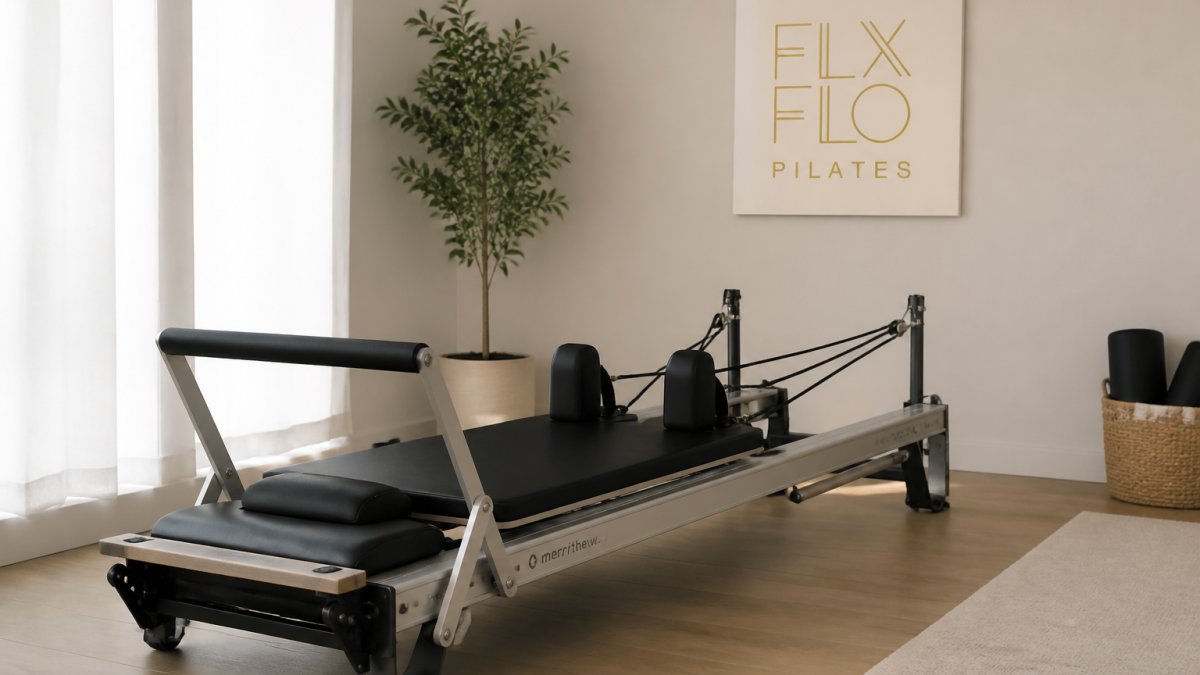
The reformer has a carriage that slides on rails, springs that provide resistance, and a footbar for use. Spring tension is adjustable, lighter springs for mobility work, heavier springs for strength. Always start with lighter resistance if you're new to the machine.
Safety first:
Check that springs are secure before each use
Keep your neck neutral, don't crane it to watch your form
Move slowly and with control, especially when learning
Stop if you feel sharp pain (mild muscle fatigue is normal; sharp pain is not)
Work with an instructor your first few sessions to learn proper alignment
Your setup should feel stable. If the machine feels wobbly or unstable, ask for help adjusting it. A reformer that's set up correctly will support your body and make the work feel easier, not harder.
Five-Minute Desk-Worker Series
This routine targets the exact areas desk work damages. Each exercise takes about one minute.
1. Cactus Arms (chest opening and shoulder mobility)
Lie on your back on the reformer with your head supported.
Press your arms back, opening your chest.
This exercise directly counters rounded shoulders from desk work.
2. All-Fours Rotation (thoracic mobility and core stability)
Position yourself on the reformer in an all-fours stance.
Rotate your torso, reaching one arm toward the ceiling. Your chest opens. Your spine rotates.
This movement restores the upper-back rotation that sitting eliminates.
3. Child's Pose with Hip Opening (hip mobility and glute activation)
From all-fours, sink your hips back toward your heels. Your arms stay extended.
Hold for 10-15 seconds.
4. Kneeling Plank with Glute Pulse (postural strengthening and glute activation)
Kneel on the reformer. Your hands press into the carriage.
Pulse your glutes 10-12 times. You should feel your glutes fire, not your lower back.
5. Triceps with Chest Engagement (arm strength and postural support)
Use the reformer's handles or footbar. Your shoulders stay down. (Source: the benefits of core strengthening)
Do 10-12 controlled reps. Tricep strength supports better posture and reduces shoulder tension.
Watch Out Common mistake: Using momentum instead of muscle control. Move slowly. If you're swinging or bouncing, the weight is too heavy or the resistance too light. Adjust and focus on feeling the muscle work, not rushing through reps.
Reformer Pilates Frequency for Beginners: How Often to Practice
Consistency beats intensity. Three to four sessions per week is the sweet spot for beginners. This gives you enough frequency to build strength and mobility while allowing your body to recover.
5 Quick Pilates Reformer Exercises For Desk Workers
Function Pilates
Here's why this matters: Your muscles need time to adapt. If you do reformer pilates five days a week as a beginner, you risk overuse and burnout. If you do it once a week, progress stalls. Three to four times weekly creates a rhythm your body responds to.
Most beginners notice postural changes within 2-3 weeks of consistent practice. Your shoulders feel less tense. Your chest opens. Your lower back feels supported. These changes compound over months.
A realistic weekly schedule looks like this:
Monday: Full reformer routine
Wednesday: Full reformer routine
Friday: Full reformer routine
Saturday or Sunday: Optional light mobility work or rest
This schedule allows recovery days while maintaining the consistency that drives results.
Pro Tip Start with three sessions per week. After four weeks, you can add a fourth if you feel ready. Listen to your body. Soreness that improves with movement is normal. Sharp pain or pain that worsens is a signal to adjust or rest.
Reformer Pilates vs Mat Pilates: Which Is Better for Your Desk Job
Both reformer and mat Pilates improve posture. The question is which one suits your needs better.
Reformer Pilates uses spring resistance to guide your body into alignment. The machine supports your spine. It's easier to maintain proper form. The springs provide feedback, you feel immediately if you're cheating or compensating. For desk workers, the reformer's support and guided resistance make it the stronger choice for postural correction.
Mat Pilates uses your body weight and gravity. It requires more stability and core engagement from the start. For beginners, mat work can be harder because there's no machine support. You have to create your own alignment cues. Over time, mat Pilates builds exceptional core strength.
The difference comes down to this: A reformer gives you immediate postural feedback and support. Mat Pilates requires you to already have decent body awareness. For desk workers who've spent years in poor posture, the reformer's guidance is invaluable.
Many people do both. They use the reformer for foundation-building and postural correction. Once their alignment improves, they add mat work for additional challenge and variety.
Common Mistakes and How to Modify for Your Body
Beginners make predictable errors. Knowing what to avoid saves time and prevents injury.
Mistake 1: Holding your breath
Many people hold their breath during effort. This creates tension and reduces core engagement. Instead, exhale as you exert force. Inhale as you return. Breathing keeps your nervous system calm and lets your core work properly.
Mistake 2: Overusing your neck
Your neck is delicate. Don't strain it to watch your form or create tension by gripping. Keep your gaze neutral. Let your neck relax. Your instructor can watch your form, you just focus on the movement.
Mistake 3: Too much resistance too soon
Lighter springs teach your body proper alignment. Heavy springs teach poor habits faster. Start light. Master the movement. Then add resistance. This progression prevents injury and builds real strength.
Mistake 4: Skipping warm-up or cool-down
Jumping straight into reformer work stiffens your joints. Spend 2-3 minutes warming up with gentle movement. After your routine, take 2-3 minutes to stretch and let your nervous system settle. This simple habit cuts soreness and improves recovery.
Modifications for different abilities:
Shoulder injury or sensitivity, Reduce range of motion on chest-opening exercises. Use lighter spring resistance. Focus on glute and hip work instead.
Lower-back pain, Avoid heavy spinal extension. Focus on core stability and glute activation. Work with an instructor to find safe positioning.
Tight hips, Spend extra time on hip-opening exercises. Use lighter resistance and longer holds. Progress slowly.
There's no shame in asking for adjustments. That's how you build strength safely.
Key Takeaway Modifications aren't weakness, they're intelligence. A lighter load with perfect form beats a heavy load with compensation patterns. Work with your body, not against it.
What to Expect: Realistic Outcomes and Timeline
Reformer pilates for desk workers produces real changes. But they happen gradually, not overnight.
Week 1-2: You'll notice improved body awareness. Your posture feels slightly better. You're sore in new places (this is normal). Your nervous system is learning the movements.
Week 3-4: Postural changes become visible. Your shoulders sit lower. Your chest feels more open. Friends might comment that you "look taller." Your energy improves because breathing becomes easier.
Week 6-8: Strength builds noticeably. You can do exercises with better form and slightly more resistance. Your lower-back pain (if you had it) often improves.
Week 12+: Postural changes become your default. You sit differently at your desk naturally. Your upper-back mobility improves significantly. Chronic tension in your neck and shoulders often resolves.
Realistic outcomes depend on consistency. If you do three sessions per week, you'll see measurable change by week 4. If you do one session per week, change takes longer.
The timeline also depends on how long you've had poor posture. Someone with five years of desk work needs more time to reset their alignment than someone with two years.
Watch Out Avoid the trap of expecting perfection. You won't have perfect posture after 12 weeks. You'll have significantly better posture, more mobility, and more awareness. That's the realistic goal. Postural habits built over years take time to fully reset.
Common Mistakes and How to Modify for Your Body
Reformer pilates for desk workers works because it targets the exact damage that sitting creates. It strengthens weak muscles, opens tight areas, and rebuilds postural awareness. The key is consistency, three to four sessions per week, proper form over heavy resistance, and patience with the process.
If you're struggling with desk posture, upper-back stiffness, or the fatigue that comes from poor alignment, reformer Pilates is worth trying. Our approach focuses on moving smarter, not harder, exactly what your body needs after hours at a desk. Book a class and experience how intentional movement can transform your posture and energy.
Frequently Asked Questions
How often should a beginner do reformer Pilates to see results?
Most beginners benefit from 2–3 sessions per week to build foundational strength and postural awareness. Consistency matters more than intensity. Many desk workers notice improved posture and reduced stiffness within 3–4 weeks at this frequency. Start with two sessions weekly if you're new to exercise, then increase to three as your body adapts. Rest days allow your muscles to recover and strengthen.
Can reformer Pilates really fix posture from sitting all day?
Reformer Pilates addresses the root causes of desk-related posture problems by activating deep core muscles, opening the chest, and restoring thoracic mobility and upper-back rotation. The spring resistance provides calibrated feedback that helps you feel and correct misalignment in real time. Results depend on consistency and awareness outside class—pairing Pilates with ergonomic desk setup and movement breaks throughout your workday accelerates improvement.
Is reformer Pilates better than mat Pilates for office workers?
Reformer Pilates offers advantages for desk workers because the springs provide adjustable resistance and support, making it easier to maintain proper alignment while building strength. The equipment guides your body through controlled movement, reducing compensation patterns that mat Pilates can sometimes reinforce if your posture is already compromised. Mat Pilates is effective too, but reformer work is often more accessible for beginners and those with existing stiffness or mobility limitations.
What should I expect in my first reformer Pilates class?
Your first class will focus on learning the equipment, understanding basic body cues, and discovering your baseline mobility and strength. An instructor will adjust the springs, demonstrate proper alignment, and show modifications for your body. Expect to feel muscles activate that you haven't used in years—this is normal and usually mild. You may feel energized or slightly sore the next day. A qualified instructor will ensure you move with control, not intensity, so you leave feeling supported, not exhausted.
Book Class