Low-Impact Strength Training in Monmouth County

Table of Contents
Why Low-Impact Strength Training Works in Monmouth County
Low-Impact Strength Exercises for Beginners
Who Each Exercise Suits
Equipment and Setup for Beginners
Reformer Pilates for Core Strength
How Reformer Springs Adjust Resistance
Beginner Reformer Pilates Classes in Monmouth County
What to Expect in Your First Class
Personal Training and Small-Group Coaching
Format Comparison for Low-Impact Goals
Accessibility and Accommodations to Ask About
How to Compare Pricing and Trial Offers
Questions to Ask Before You Commit
How to Evaluate Low-Impact Programs and Pricing
Last Updated: October 14, 2026
Why Low-Impact Strength Training Works in Monmouth County
Low-impact strength training builds muscle and bone strength without the joint pounding of running, jumping, or heavy max lifts. For adults managing old injuries, desk-job posture, or simply a 40-to-60-year-old body, that distinction matters.
Intensity is not the same thing as impact.
The CDC's physical activity guidance for adults recommends at least two days per week of muscle-strengthening activity, and it does not require those sessions to be high-impact to count.
Key Takeaway Low-impact does not mean low-effort. Controlled resistance, tempo, and range of motion are what create the training stimulus, not bouncing or heavy loading.
Low-Impact Strength Exercises for Beginners
The best beginner exercises are the ones you can repeat twice a week without paying for it the next day. Start with movements that train large muscle groups while keeping one foot grounded or your back supported.
For knees and hips
Glute bridges: Hips lift off the floor, spine neutral. Trains glutes and hamstrings. If your lower back arches, tuck your ribs down and press through your heels.
Step-ups to a low platform: Builds single-leg strength and balance with minimal joint stress. Use a height where your knee stays at or below 90 degrees, and step down backward if forward feels sharp.
Sit-to-stands from a firm chair: The most transferable strength movement there is. Use your hands on the chair arms as needed, then wean off them.
For shoulders and wrists
Wall or incline push-ups: Hands on a wall or bench reduce load on wrists and shoulders; the higher the surface, the easier. Wrist discomfort usually means your hands are too far forward, stack them under your shoulders.
Band pull-aparts: A light band held at chest height, pulled apart with straight arms. Trains the upper back and rear shoulders without any pressing load.
For the spine and core
Seated rows with a band: Trains the mid-back most desk workers need. Anchor the band at chest height and keep your torso still, the arms move, not your low back.
Dead bugs: Core stability without any spinal loading. Press your low back gently into the floor the entire time; if it lifts, reduce your range of motion.
Bird dogs: Opposite arm and leg extend from all fours. Slower is harder here, not easier.
For grip and posture
Farmer carries with light weights: Grip, posture, and walking stability in one. Walk 20 to 30 steps, set the weights down under control, rest, repeat.
A common mistake is adding load before you own the movement pattern. Spend two to three weeks on bodyweight and band versions. A simple progression: two sets of eight controlled reps, then three sets of eight, then add light resistance and drop back to two sets of eight.
Who Each Exercise Suits
Not every beginner should start in the same place. Use this as a rough filter, and check with a physician or physical therapist first if you are managing a diagnosed condition.
Brand-new to strength training: Start with sit-to-stands, wall push-ups, glute bridges, and dead bugs. These four cover the major patterns with the least coordination demand.
Older adults or anyone returning after a long layoff: Prioritize sit-to-stands and farmer carries for balance and gait, and keep step heights low.
Managing shoulder discomfort: Favor band pull-aparts, seated rows, and incline push-ups at a high angle. Skip overhead pressing until you have been assessed.
Equipment and Setup for Beginners
You need very little to start: a resistance band, light dumbbells, and a stable chair or bench. A mat helps for floor work. Setup matters more than gear.
Set up where you can lie flat and stand up without obstruction.
Keep a chair nearby for balance during single-leg work.
Start with two sets of eight to ten controlled reps per exercise.
Pro Tip Film one set on your phone from the side. Most beginners are surprised by how much their lower back arches during bridges and rows. Fixing that one detail improves results faster than adding weight.
Key Takeaway Pick one exercise per joint category above, not one per bullet. Four to six total movements, done twice a week, will outperform a long list done inconsistently.
Reformer Pilates for Core Strength
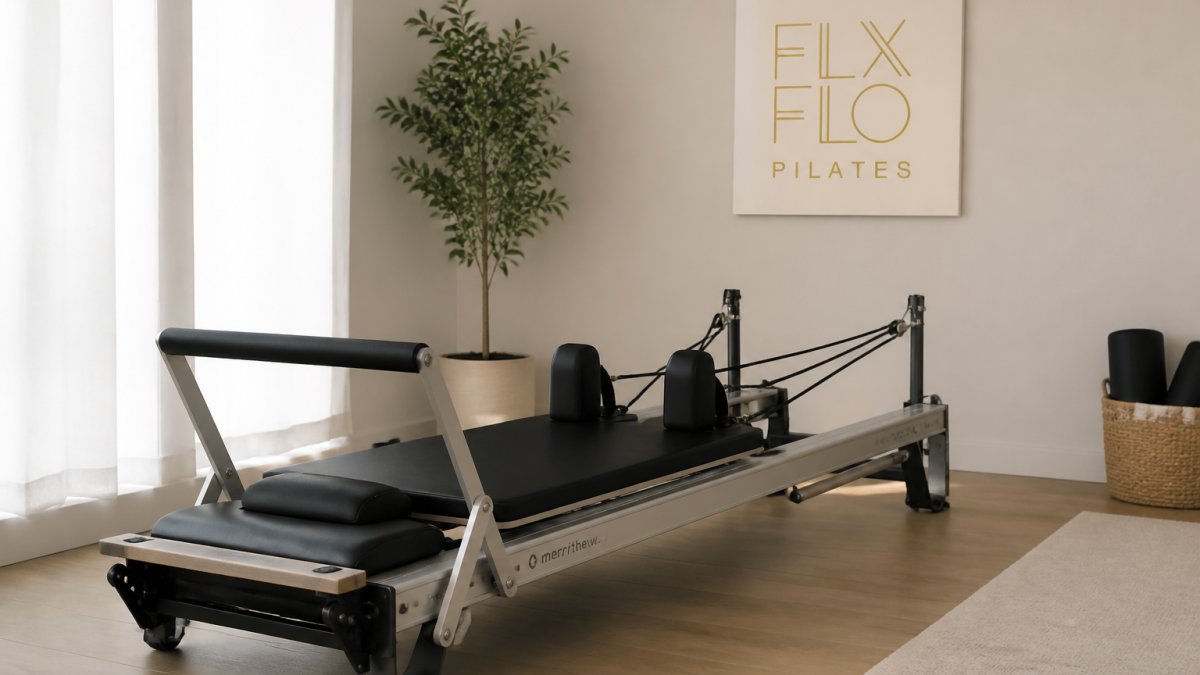
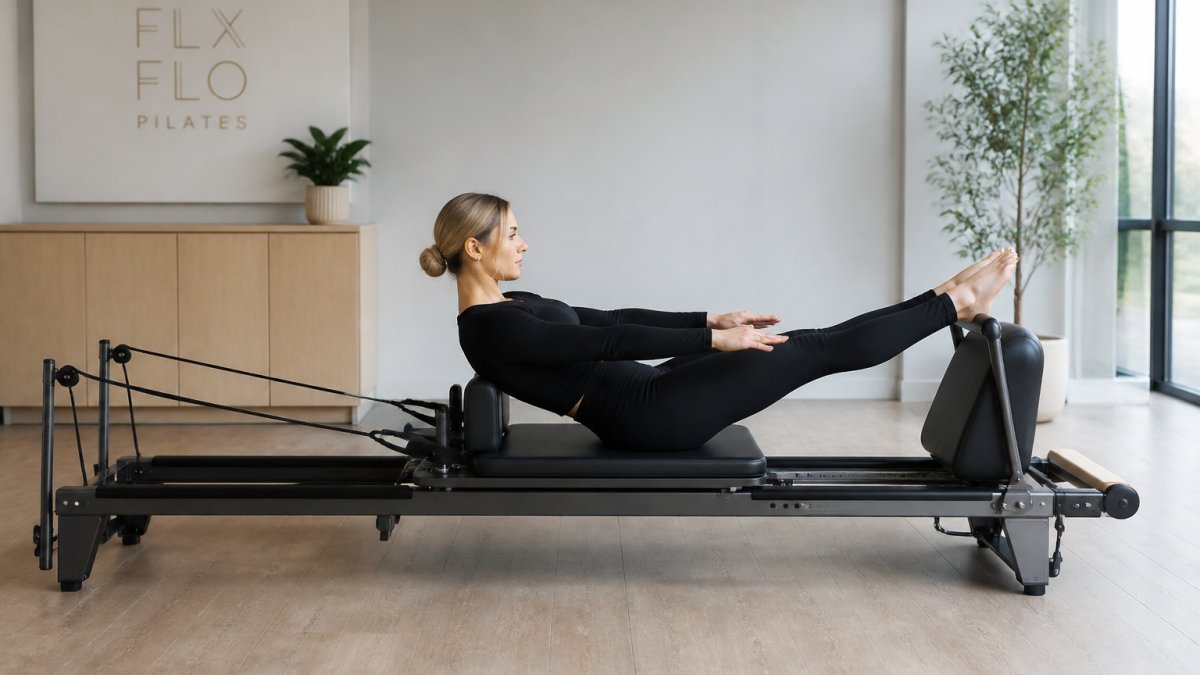
Reformer Pilates for core strength uses a sliding carriage, springs, and straps to create adjustable resistance while your spine stays supported.

The emphasis is deep core activation and postural integrity rather than rep count, building strength that carries into how you sit, stand, and lift outside the studio.
How Reformer Springs Adjust Resistance
Springs change how much resistance you feel and in which direction: fewer or lighter springs make a movement easier, more springs increase the challenge. The carriage adds an unstable element, so stabilizer muscles stay engaged.
That is why two people can do the same exercise at very different difficulty levels. Your instructor adjusts the springs to match your shoulder, back, or hip limitations on any given day.
Beginner Reformer Pilates Classes in Monmouth County
Beginner reformer Pilates classes in Monmouth County teach the equipment before pushing intensity. A good intro class covers carriage control, spring selection, breathing, and modifications. At FLX FLO Pilates, every session is built around moving smarter rather than harder, with a focus on postural integrity, deep core activation, and sustainable strength.
When you compare options, ask three questions:
What to Check | Why It Matters | What to Look For |
Class size | Smaller groups mean more hands-on correction | Capped beginner class sizes |
Instructor credentials | Determines how safely modifications are handled | Verifiable certification and training |
Trial or intro offer | Lets you assess fit before committing | A free consultation or intro session |
What to Expect in Your First Class
Expect to spend the first session learning, not sweating. Your instructor walks you through the reformer, sets your spring resistance, and watches your form. Most beginners feel their core working within the first few exercises and notice posture changes within a handful of sessions.
If you are recovering from an injury or managing a physical limitation, tell your instructor before class starts. That is the difference between a safe modification and a setback.
Watch Out Skipping the setup conversation is the most common beginner mistake. If an instructor does not ask about your injury history or adjust springs for you, that is a signal to look elsewhere.
Personal Training and Small-Group Coaching
Personal training and small-group coaching apply the same low-impact principles with more individual attention. One-on-one suits specific injuries, rehab goals, or performance targets. Small-group coaching splits the difference: individual corrections at lower cost than private sessions, plus the accountability of a scheduled class.
If your main barrier is motivation, group training usually wins, the appointment and the people keep you consistent. If it is a physical limitation, individual coaching wins because the whole session is built around your body.
Format Comparison for Low-Impact Goals
Format | Typical Group Size | Best For | Watch For |
One-on-one personal training | 1 | Post-rehab, specific injury, sport-specific goals | Highest per-session cost; requires the most scheduling flexibility |
Duet or partner training | 2 | A spouse, friend, or training partner with similar goals | Sessions move at the slower partner's pace |
Small-group coaching | Roughly 4 to 8 | Beginners who want corrections plus accountability | Ask whether the trainer caps the group and whether they screen for injuries |
Large group classes | 10+ | General conditioning once you already know the movements | Limited individual correction; not ideal for active injuries |
Accessibility and Accommodations to Ask About
Low-impact training only works if you can get to the equipment and use it. Before booking, ask each provider directly about the following, and verify the answers yourself.
Step-free access: Is there an elevator, ramp, or ground-floor entrance between the parking area and the training space?
Seated options: Can the trainer run a full session seated, or adapt standing movements to a chair?
Adaptive equipment: Are there bands, light dumbbells, stability balls, and blocks available, or do you need to bring your own?
If a provider cannot answer these questions clearly, that is useful information. A studio that regularly serves older adults and clients in recovery will have answers ready.
How to Compare Pricing and Trial Offers
Pricing for personal training and small-group coaching varies by format, session length, and whether you buy a single session, a package, or a membership. Rather than quote figures that go stale, use these questions to compare providers:
What is the per-session cost at each package size (single, 5-pack, 10-pack, monthly)?
Does the price change for duet or small-group sessions versus one-on-one?
Is there a free consultation, intro session, or trial class, and what does it include?
Ask for the answers in writing. A provider that lists current pricing on its website is easier to compare than one that only quotes over the phone.
Questions to Ask Before You Commit
A short screening conversation tells you more than a tour. Ask these before you pay for anything:
How do you modify a session for a client with knee, shoulder, or low back limitations?
Do you screen for injuries and movement restrictions before the first session?
What certifications do you hold, and how do you keep them current?
How many clients do you train at once, and how do you split your attention?
What does a typical first month look like for a beginner?
If I have a flare-up, how do we adjust the plan?
Many people combine formats: a weekly private session for problem areas plus group classes for conditioning and consistency, often the fastest progress for beginners managing old injuries.
Watch Out If a trainer will not discuss your injury history, will not adjust exercises on the spot, or pushes you toward heavy loading in your first sessions, look elsewhere. Low-impact training depends on the trainer's willingness to modify, not on the label on the door.
How to Evaluate Low-Impact Programs and Pricing
Evaluating a low-impact program comes down to five things: instructor qualification, class size, modification skill, trial access, and pricing transparency. Ask for all five before you book.
Instructors hold verifiable certifications and ongoing training
Beginner classes are capped so you get hands-on correction
The studio asks about injuries and adjusts exercises accordingly
Pricing for reformer Pilates varies by studio, class format, and membership structure, so we recommend checking each provider's own pricing page rather than relying on secondhand figures. FLX FLO Pilates lists current class and membership pricing on our website, along with a new client intro offer so you can experience different classes types and instructors that fit your schedule before deciding.
For broader context on how strength training fits into overall health, the American College of Sports Medicine position stands outline resistance training guidance for adults, and the National Institute on Aging exercise resources cover safe strength work for older adults.
Best For Adults 40-60 in Monmouth County who want to build real strength without aggravating old injuries, plus beginners who feel intimidated by traditional gyms.
Building strength after 40, or after an injury, does not require punishing your joints. It requires the right method, qualified instruction, and a program that adapts as you do. FLX FLO Pilates offers reformer Pilates built on postural integrity, deep core activation, and sustainable strength, with beginner-friendly classes and personalized coaching in a supportive environment. Book a class with FLX FLO Pilates and start moving smarter, not harder.
Book Class